

Through it all, this Greek church in Mattituck endures
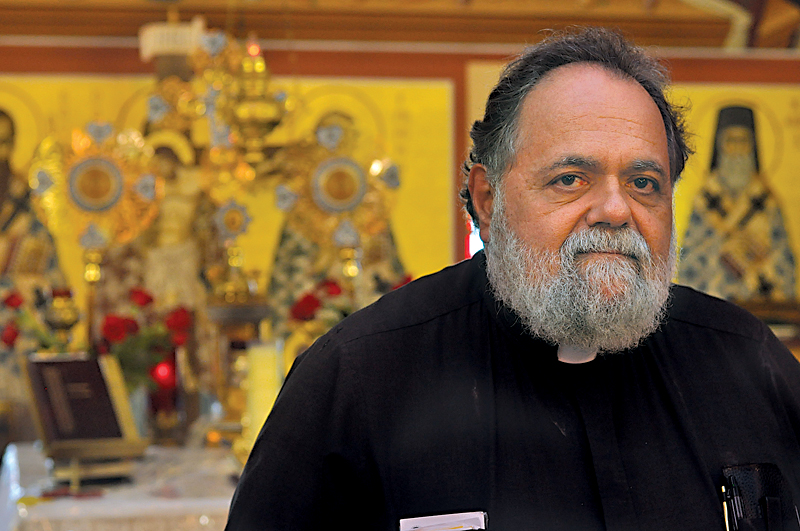
It’s 3 p.m. Monday and Father Constantine Makrinos is behind his desk at Transfiguration of Christ Greek Orthodox Church in Mattituck.
A priest of 30 years, Father Makrinos’ spiritual journey has led him from Detroit, Mich., to Newark, N.J., to Ocean City, Md.
The son of a Greek immigrant who worked as a coal miner in the hills of West Virginia, he has spent the past six years at the church built on a former potato farm along Breakwater Road.
On this particular afternoon, the phone in Father Makrinos’ study rings often.
It’s the last week in July, which for many represents the one weekend a year they visit the church. That’s the usual date of the church’s popular Greek Festival, during which Greeks and non-Greeks alike visit the property to enjoy Mediterranean cuisine, craft vendors and rides for children.
But with each and every phone call, Father Makrinos finds himself the bearer of bad news.
“I have to tell them we are not having a festival this year,” he said moments after one call. “Our workers are not here, I tell them. They are in Greece.”
The festival, which has been more popular than ever in recent years, is a local victim of Greece’s economic crisis, which Father Makrinos said has forced many of the men and women who volunteer at the annual event to return to their homeland to protect family real estate interests.
For a church that has seen a decline in attendance since 2000, the cancellation of the festival, which raised more than $50,000 in 2014, creates a hardship.
But for a church founded more than 50 years ago on the backs of working class immigrants, this is just one more obstacle to overcome.
Photo: Father Constantine Makrinos inside Transfiguration of Christ Greek Orthodox Church in Mattituck, where he has served for the past 6 1/2 years. (Credit: Grant Parpan)
THE BIRTH OF A CHURCH
Catherine Tsounis, the daughter of founding church members, has been documenting history at Transfiguration of Christ for as long as it has existed.
A teacher and real estate broker by trade, she has a passion for telling the story of her house of worship. And she wants to get it right.
As she sits on a couch in Father Makrinos’ study, a bound volume rests on her lap. Inside is the story of how a church and an ethnic community were born.
Each page contains press clippings from The Suffolk Times, Newsday and the former Watchman newspapers. Many more of the archived articles were written for various Greek and religious publications by Ms. Tsounis herself — the church historian and a title she takes seriously.
“This is very important,” she said, her brows arching ever so slightly above her eyeglasses as she emphasizes her words. “The future generations of this church need to know how it all began and it needs to be accurate.”
The press clippings tell the story of the origins of the church, which dates back to 1968. That’s when the North Fork Greek Community Association was founded with the purpose of starting a Greek Orthodox Church within the Mattituck community.
Ms. Tsounis said that since the church property abuts Douglas Cooper Farms, many people believe it was once a part of that farm. But the land was actually a potato farm belonging to the late Stanley Sledjeski, a local farmer and real estate broker, who sold his property at below market value at the suggestion of his wife, Helen, a religious woman.
The church’s first president, Theofan Kyvernitis, a Cypriot immigrant and businessman, acquired the land and donated it for construction of the church. Architect Steve Tsontakis donated his services in designing the building. Many of the funds needed to build the church were raised through modest measures, such as weekly cake sales.
A groundbreaking was held on Breakwater Road in the fall of 1969 and liturgy was conducted at the nearby Church of the Redeemer in Mattituck until Transfiguration of Christ opened its doors in 1970.
It was the first Greek church built on the East End.
Transfiguration of Christ was founded by Cypriot immigrants like Mr. Kyvernitis, who had settled, mostly seasonally, in Mattituck during the 1960s.
In the 1950s and 1960s, during periods of political instability and economic recession, nearly 80,000 people left the island of Cyprus, many of them settling in New York City and Long Island.
“This church, like many Greek churches in America, was built by working class people,” Father Makrinos said. “These were not rich people and they built it from scratch.”
By the early 1980s, a “Greek colony” had sprung up in the surrounding area, said Ms. Tsounis, who estimated that approximately 60 Greek families still own homes within blocks of the church.
Church leaders gave several reasons why so many Greek families were attracted to the Mattituck area.
Ms. Tsounis said the North Shore beaches reminded church founders of the rocky terrain of Cyprus. Her husband, John Siolas, an associate professor at St. John’s University in Queens and a former Parish Council secretary, said the agricultural roots of the Mattituck community were also appealing to Greeks, many of whom planted their own gardens here.
Of course, Mr. Siolas said, the vast open spaces and the fact that land could be purchased for less on the North Fork than the south also made Mattituck a more desirable location.
Ms. Tsounis said many of the founding members of Mattituck’s Greek community purchased old bungalows along the water that they replaced with larger villas.
“They uplifted the neighborhood,” she said. “They really helped to raise real estate values here.”
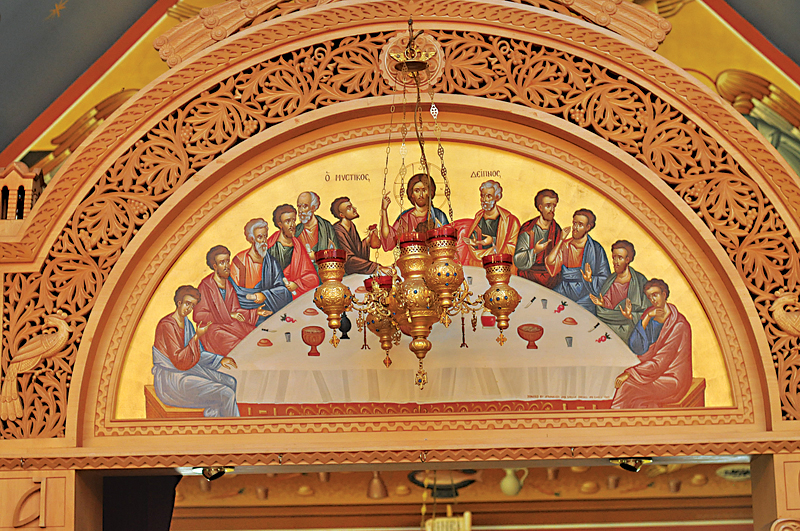
Photo: An icon of the Last Supper rests above the altar at Transfiguration of Christ Church. The church’s icons, designed by George Filipakis, are in the Cretan style. ‘It’s brighter colors [than the Mediterranean style],’ said Father Constantine Makrinos. ‘It’s more approachable. Jesus is a sweet Jesus.’ (Credit: Grant Parpan)
PERIODS OF STRUGGLE
On the evening of Nov. 27, 1984, a fire broke out at Transfiguration of Christ. Volunteers from the Mattituck and Cutchogue fire departments battled the blaze for more than two hours, with over 65 firefighters and six pieces of equipment at the scene.
With two arsons reported in Mattituck in the previous three months, investigators suspected the church fire could have been set intentionally, The Suffolk Times reported at the time.
As it turned out, the fire was actually caused by a lit candle in the altar area, which burned an adjacent partition and caused significant damage to the interior of the church.
Over the next four years, the community rallied, adopting the motto “Together we will grow.” Services were held in the church basement during this time.
Architect Gordon Ahlers of Jamesport designed the reconstruction, which was completed by O’Neill Builders of Bayport.
But like the first time around, much of the church’s effort to restore was driven by middle-class Greek residents of the North Fork. The church’s single largest donor was Peter Phillips, a man of fairly modest means, who donated a 45-foot-long handcrafted altar that cost more than $58,000 to construct.
“At that time one could buy two houses in Mattituck for that price,” Ms. Tsounis said.
The total reconstruction cost was nearly a quarter of a million dollars, according to an article Ms. Tsounis wrote earlier this month for greekreporter.com. The effort began with $80,000 in insurance money and was completed with about $150,000 raised by the community.
At its peak, Transfiguration of Christ was bursting at the seams with members, more than 350 of them filling every pew, even in wintertime.
But with another Greek church since established in Greenport and a larger $20 million church constructed in Southampton, the Mattituck church now draws from a smaller pool of congregants.
Perhaps the biggest change, church leaders say, is in the demographic. For more than 30 years, Ms. Tsounis ran a Sunday School for children at the church, but it closed more than a decade ago as the church population aged.
Today, about 200 members attend liturgy on a busy summer day, but only about 25 people, all of whom are retired, attend regularly in winter.
Father Makrinos blames this decline on a lack of jobs for young people in the area, a phenomenon impacting more than just the Greek community.
While the church founders have mostly passed away and the second generation has aged, third- and fourth-generation churchgoers have stayed in New York City, where they can find work.
“When I talk to young people about getting involved in the church they say, ‘Father, I’m only here when I’m on vacation,’ı” he said.
Father Makrinos said the youngest member of the Parish Council, which runs the church, is over 70. The oldest member is in his 90s.
When asked what that means for the future of the church, the priest slowly removed his hands from behind his head and gestured with both hands.
“I don’t know,” he said.
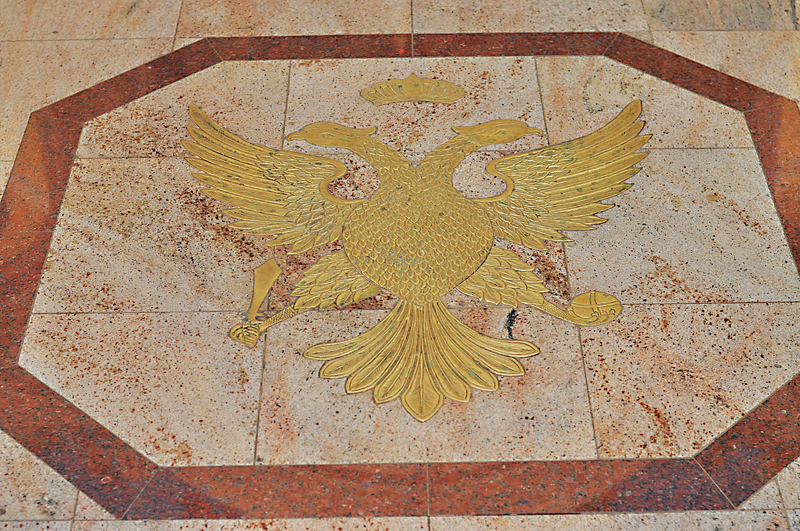
Photo: The symbol of the double-headed eagle was carried down by the Greek Orthodox Church from its Byzantine legacy. In Byzantine culture, the heads represent the emperor’s authority over both secular and religious matters, though church officials said today it also signifies keeping an eye on both the Eastern and Western worlds. (Credit: Grant Parpan)
THE FUTURE OF A COMMUNITY
Ms. Tsounis says that in order to fully understand the impact a Greek Orthodox Church has on a community you must understand that there is very little separation between the two.
“It’s more than just being a church. It represents our culture, our civilization,” she said. “We never had a government. The church was our government.”
That principle defines the strength of Transfiguration of Christ, especially in times of weakness, she said.
When the church found it was operating at a deficit in 2013, then-council president Anthony Coutsouros sent a letter to every parishioner.
“I am writing to you on a very important subject,” he wrote. “Your beloved church, at present, is in a dire situation: We have a very low Sunday attendance; our church membership is very low; contributions are very low. I appeal to you to come to church.”
The church was forced to cut its operating budget by more than $2,000 a month and to rely on services donated by its members.
Perhaps the biggest change, Ms. Tsounis said, was the reintegration of English into church life to make it more accessible to the younger generations, which church leaders say has helped.
A renewed emphasis on the annual Greek Festival also helped bring more attention and money to the church. The Parish Council spread posters announcing the festival across the entire North Fork in 2013, bringing record attendance to the event each of the past two years.
Without the required number of workers to operate the festival, church leadership has had to make up the more than $50,000 generated last year, by again reaching out to the community for help. So far, more than $43,000 has been raised through donations from parishioners.
The difference, leadership hopes, can be made up through a pair of upcoming events. An evening of modern Greek music and dancing, dubbed the “End of Summer Greek Glendi” is planned for Sunday, Sept. 6, at 6 p.m. A “Kafenio Night,” Greek for café, will be held at 6 p.m. on Saturday, Aug. 15. The evening of food and music marks the end of a two-week period of fasting for church members.
There is, of course, one exception to that period of fasting, as the church marks the Feast of the Transfiguration on Thursday, Aug. 6.
On that evening, Father Makrinos said, more than 200 members will likely visit the church to celebrate the episode in the New Testament for which the church gets its name. In that story, Jesus ascends a mountaintop with three of his apostles and shines with bright rays of light as a voice, assumed to be God’s, calls him son.
The transfiguration is depicted in one of the icons at the church’s altar. The many icons that decorate the church, all donated by parishioners, are what Father Makrinos calls the church’s greatest feature.
The icons depict the stories of the Bible, but in the way the icons were acquired they also tell the story of the church: one built and rebuilt through the generosity of the families that founded it.
Ms. Tsounis said she finds hope for the future of Transfiguration of Christ in the sons and daughters of the church’s youngest members. She hopes that as the younger generation of Mattituck’s Greek community starts families of their own, they will reconnect with the church they were raised in. She said there is already evidence of this happening.
“Greek churches don’t close,” she said. “Our churches are our communities. We are our church.”
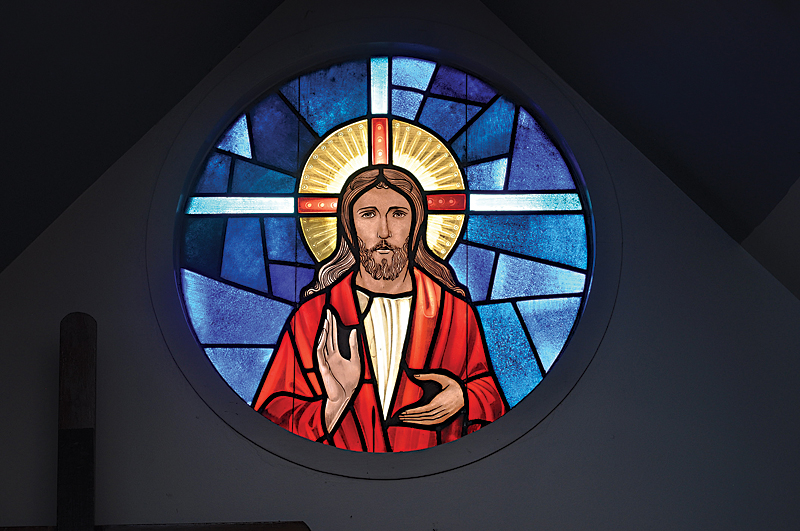
Photo: A stained-glass depiction of Jesus faces the altar from above the church’s front entrance. (Credit: Grant Parpan)