

Mattituck grad rides motorcycle 2K miles across Vietnam
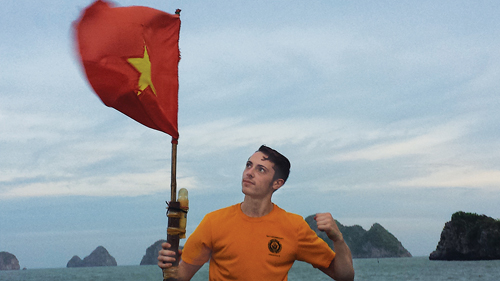
When Ian Husak first arrived in Vietnam, he didn’t have the benefit of international data on his phone. There was no GPS in his pocket to direct the Mattituck High School graduate from Ho Chi Minh City to Mui Ne, a journey of more than 130 miles on a motorcycle across foreign terrain.
“I had no map,” he recalled. “I spent the whole day wondering, ‘Am I going the right way?’ ”
In a way, that uncertainty was a key experience for Mr. Husak, a sophomore at Fordham University. Along with a more nuanced global perspective, he said the greatest reward from his month-long trip was learning to live in the moment.
“I had to learn to enjoy being lost,” he said. “As a person, I like knowing where I’m going and having a plan. But you develop a sense that you’ll get there when you get there.”
Mr. Husak had known since high school that he wanted to see the world. A documentary on Vietnam and an episode of the BBC television series “Top Gear” convinced him that the quickly growing Southeast Asian country would be his first destination.
From May 17 to June 12, he took the plunge and pursued that goal.
“I just think that was so brave,” said Gary Buckner, Mr. Husak’s former social studies teacher at Mattituck High School. “Most kids, if they do go away after high school — which many don’t — usually go to Europe. But Ian had this fixation on Vietnam and I loved it. I thought it was fantastic.”
Before Mr. Husak left, Mr. Buckner gave him some advice on exploring the world.
“Be a sponge,” Mr. Buckner recalled telling him. “Keep your mind open and absorb what is out there. Trust everyone until you’re given reason not to.”
In total, Mr. Husak traveled about 2,000 miles on a Honda Win 110cc he bought for $300 his first day in Vietnam. His journey took him from Ho Chi Minh City in the southern part of the country all the way to Sa Pa, in northwestern Vietnam, near the border of China.
His favorite part was the cuisine, especially since he could get a bowl of pho (Vietnamese noodle soup) for a dollar or two at every meal. He estimated that his trip cost about $1,500.
“You can live on $15 a day including hotels and food,” he said.
Perhaps dauntingly for some, Mr. Husak arrived at and departed from Vietnam without a single companion.
“If you’re by yourself, you’re so much more open to meeting new people and talking to new people,” he said.
He spent the majority of his trip with three documentarians from Lebanon who he met at a hostel in Mui Ne.
“I’ve been telling my classes for 20 years that you’re never alone when you’re traveling,” Mr. Buckner said. “There are people you meet that are doing the same thing as you … You get to know people, and you find out about their culture.”
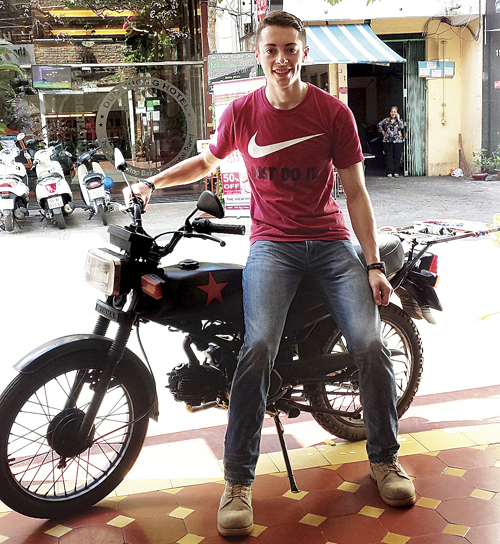
Mr. Husak even made it into the documentary his new friends were making about Vietnam.
“They do amazing stuff,” he said. “They’re better than National Geographic, to be completely honest. And that’s one of the best parts about meeting these guys: not only have I made incredible friends, but I’ll have this amazing, professional video of my trip.”
The group biked together and sometimes took trains as they made their way north, interacting with locals along the way. Once they parted ways in Hanoi, Mr. Husak went to Fansipan, the tallest mountain in Indochina, to hike.
“I said, ‘If I’m gonna hike, I’m gonna hike the tallest mountain,’ ” he said.
Mr. Husak was able to get by with English or with the aid of Google Translate.
“It’s amazing what you can communicate with facial expressions and miming,” he said.
He found that the specter of the Vietnam War still lingers in the country, but in a different way — and he believes his perspective benefited from learning that difference.
“It’s important to go to these places and talk to people about the war,” he said. “In America, people think of Vietnam as a war, not a country … It was important for me to go there and to come back and show people that it is indeed a country.”
Mr. Husak advised his peers to have candid conversations while traveling to gain a greater sense of where they fit in the world. Americans often have a one-sided view of the world, he said.
Such insight is what Mr. Buckner hopes all of his students can gain from traveling.
“From 18 to 29 is all about the search, who you are,” he said. “I think travel begins to put some of that in perspective … It certainly changed my life. That’s why I became a teacher.”
As for his peers, Mr. Husak has a tip for anyone looking to emulate his adventure: commit.
“Do something that forces you to have to go,” he said. “Buy the plane ticket. Book a hotel. Do it so you know you have to go, so there’s no turning back.”
Mr. Husak, however, said he is not satisfied with just one trip. He’s now planning to take another long journey next summer, preferably to Australia.
But that trip requires a travel partner for financial reasons. And if Australia falls through?
“Who knows? I might end up going to see the guys in Lebanon,” he said with a gleam in his eyes.
And there is that exact in-the-moment, day-to-day attitude he learned in Vietnam.