

Beetlemania: Insect poses long-term threat to Pine Barrens
The southern pine beetle, as it turns out, isn’t all that southern anymore.
The voracious and highly destructive insect — which decimates millions of cubic feet of timber across the country each year — has been making a slow expansion north over the past couple of decades. The beetle arrived in New Jersey in 2001, crossed the Great Egg Harbor River south of Atlantic City in 2008 and arrived on Long Island this past fall.
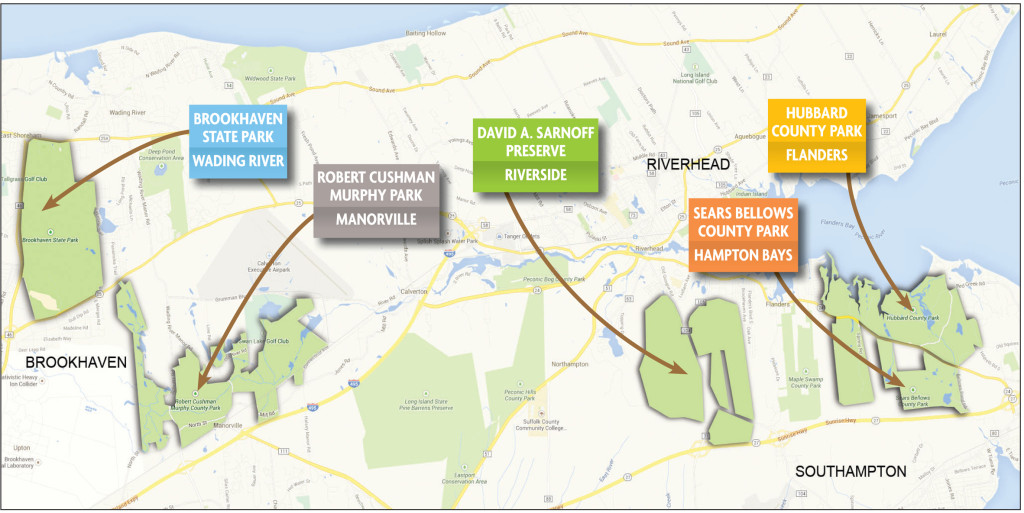
Now, authorities are trying to figure out how to contain the spread of the pest in the Pine Barrens and beyond. So far, it has infected trees at least a dozen state and county parks across Suffolk County (see map, above), not to mention on private land.
“We assume that all in all, we’ve lost a good thousand acres,” said John Wernet, regional forester with the Department of Environmental Conservation. The DEC, in conjunction with other agencies, is conducting aerial and ground surveys to determine the full extent of the damage. Results are expected in the next couple of months.
THE THREE STAGES OF A SOUTHERN PINE BEETLE INFESTATION
The levels of infestation are bound to affect the health of the Pine Barrens for years to come.
“It’s not possible to eliminate,” said Kevin Dodds, an entomologist with the U.S. Forest Service. “I hear a lot of people use the word ‘control,’ but ‘control’ implies you have the ability to knock things back. It’s better to look at this as managing it.”
CLIMBING NORTH
A few years ago, Rob Corcory, who had retired from a 37-year career with the New Jersey State Forestry Services Department, was asked to return as the state’s southern pine beetle project manager.
By then, however, scientists estimated that it was just too late to stymie the insect’s northward march.
“We tried to keep it in the southern half of the state, but it started creeping north. Everything was below the Mullica River [in New Jersey] until a year or two,” Mr. Corcory said.
 Scientists have attributed the beetle’s northern migration to climate change. The coldest night of winter in New Jersey is now seven to eight degrees warmer, on average, than it was 50 years ago, said Matthew Ayres, professor of biological sciences at Dartmouth College. And warmer temperatures at night have allowed the beetle to survive the farther north it goes.
On Long Island, temperatures recorded this past winter at the National Weather Service in Upton dropped to -4 degrees on three nights in February, which helped suppress the beetle’s spread this spring and “bought us some time” to fight this year’s infestation, said Mr. Wernet of the DEC.
It remains unclear exactly how the beetle arrived on Long Island, but its presence has now been confirmed as far north as Hartford, Conn.
It’s been speculated the beetles washed ashore on Long Island during Superstorm Sandy, Mr. Dodds said. Or it “could have just spread in smaller infestations,” he said.
What is clear is that they’re here.
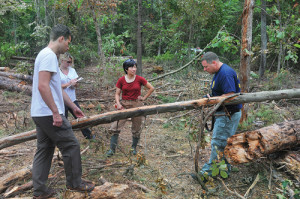
Caption: Researchers from Dartmouth College and the New Jersey Forest Service discuss southern pine beetle management in the New Jersey Pinelands. (Courtesy: Matt Ayres/Dartmouth College)
EFFORTS TO STOP THE SPREAD
Since the southern pine beetle was first detected on Long Island this past fall in Shirley’s Wertheim National Wildlife Refuge, the DEC has been working with the U.S. Forest Service, U.S. Fish & Wildlife Service, Central Pine Barrens Commission and individual towns to keep the insects in check.
Thus far on Long Island, most of the devastation has occurred at Wertheim and Connetquot River State Park, Mr. Wernet said.
Moving forward, the effort to track and contain the insect will involve several steps, said John Pavacic, executive director of the Pine Barrens Authority. The state-created entity oversees 100,000 acres of preserved woodlands in eastern Brookhaven, western Southampton and southwestern Riverhead towns.
THE BITING FACTS:
• Scientific name: Dendroctonus frontalis
• Measurements: 3 millimeters long (about the size of a grain of rice)
• It takes close to 5,000 southern pine beetles to kill a pine tree 15 inches in diameter.
• From 1999 to 2002, a southern pine beetle outbreak in the southern U.S. caused over $1 billion in economic losses.
• The southern pine beetle is also abundant in Central America. Over 225,000 acres were ruined there from 1999 to 2002.
• The largest southern pine beetle infestation on Long Island to date is believed to be at Wertheim National Wildlife Refuge in Shirley.
Sources: N.Y. Department of Environmental Conservation, N.J. State Forestry Services, interviews with Kevin Dodds and Matt Ayres.
First, aerial reconnaissance is done to spot browned trees, which are assumed to be infested. Those flights began in the area this past December. Data from the flights is then logged into a mapping system that allows ground surveyors to head out on foot and inspect the targeted areas. Once an infected area is verified, “suppression efforts” begin. For a small site, it could be as simple as using state sawyers to clear cut a few acres. But for larger ones — such as Henry’s Hollow in Hampton Bays, where 14.4 acres were recently cleared — outside contractors are hired to also cut down healthy surrounding trees that have yet to be infected.
Simultaneously, southern pine beetle traps are set up throughout the area to heal gauge the extent of the infestation.
New York State is a member of the Northeast Fire Compact, which in recent weeks sent crews from the federal government, other states and even Canada to help with ground surveying efforts. In addition, $57,000 in federal funds was allocated to cover the crews’ travel, lodging and meal costs.
The additional ground surveyors will give officials a better idea of exactly where to focus suppression efforts next winter. Due to limited resources, however, the surveying process will take quite a while — at least through the summer.
As Long Island’s only regional forester, Mr. Wernet is officially a “department of one,” he said.
LONG-TERM IMPACTS
Pitch pines — one of the southern pine beetle’s favorite hosts — are the dominant type of tree in the Pine Barrens, Mr. Pavacic said. And in some places, those are the only type of tree. So long term, he said, the infestation could prove to be “a potentially major threat” to the ecosystem.
The exact nature of that potential threat remains unclear, especially since the Pine Barrens protects Long Island’s freshwater aquifer, which provides drinking water to the island.
“We’re blessed with having such a large single-source aquifer, so hopefully it won’t affect it all that much,” Mr. Wernet said. “But I would say if we [change] the dominant tree type all at once, that would have to affect it. I don’t know how.”
What to do with the felled trees also remains a question. Mr. Dodds of the U.S. Forest Service pointed out that in some parts of the country, the logging industry is robust and companies can competitively bid on and handle salvaged timber. But that’s not the case on Long Island. Trees could simply be left to rot, creating potential tinder for future forest fires.
Dick Amper is the executive director of the Pine Barrens Society, a nonprofit organization “focusing on protecting drinking water and open space, especially in Long Island’s Pine Barrens.” Despite the lack of available resources, he estimated that it “is going to take millions upon millions of dollars and at least 10 years to get this under any kind of control. This is a disaster of the highest order of magnitude.”
While Mr. Wernet recognizes the threat the beetles pose, he said he sees a “glimmer of hope” in that southern pine beetle population — at least now — seems to be relatively small on the East End, he said.
Survey results expected later this year will tell the tale.