

Lawsuit brings unintended consequence to deer cull

Last year, a total of 30 deer that had wandered onto Half Hollow Nurseries in Laurel were shot and killed. The shootings were all legal, allowed by off-season nuisance permits issued by the state.
This year, not a single deer has been killed there during the off-season, said general manager Karl Novak.
The same goes for farmers across New York State. None was able to kill deer — at least not legally.
When a state Supreme Court judge issued a restraining order in March as part of a lawsuit over a controversial deer cull program organized through the Long Island Farm Bureau, the goal was to prevent the state Department of Environmental Conservation from continuing to issue permits to federally trained sharpshooters.
But farmers and elected officials say an unintended consequence of the injunction has prevented the government from handing out nuisance permits to farmers.
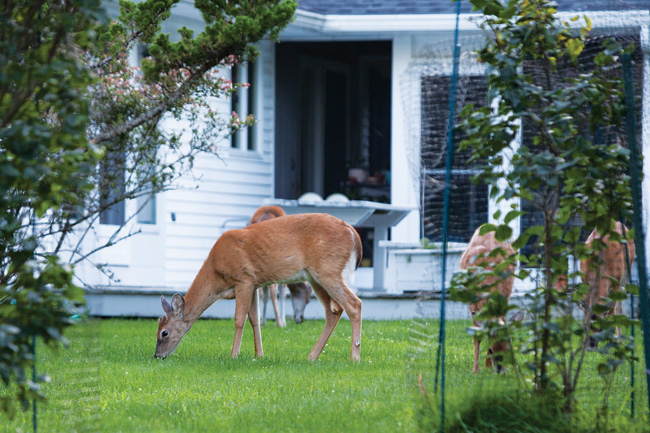
The result, some say, could be an “explosion” in what many already consider an out-of-control deer population, as farmers are unable to legally kill deer on their property before they breed.
“This suit better get settled quick, because you’re going to see deer like you’ve never seen before,” said Jamesport farmer and Riverhead Town Councilman George Gabrielsen.
Nuisance permits allow farmers to hunt on their own land outside the normal hunting season using tags. A majority of the tags are for does, which are specifically targeted as a way of curtailing the deer population.
“It’s not meant to be used as a prize hunting permit; it’s to control the deer on the farm,” Long Island Farm Bureau executive director Joseph Gergela said of the nuisance permit program.
The DEC issued 25 deer damage permits across Southold Town in 2013, spokesperson Bill Fonda told The Suffolk Times in February. The number of deer that can be killed under each permit varies from five to roughly 100, according to DEC documentation.
Despite numerous calls, a spokesperson for the DEC did not comment on the current nuisance permit issues.
Mr. Novak said farmers who would normally be removing deer from their properties are now left hoping the restraining order can be lifted.
“Our strategy right now is wait and see, because there really is no alternative for us,” he said.
While the permits alone aren’t enough to manage the North Fork’s deer population, Mr. Novak said they were a “good tool in our arsenal to at least affect the deer population.”
“That’s just another tool taken out of our hands,” he said.
The indefinite restraining order was issued by a state Supreme Court judge after opponents of the deer cull filed a lawsuit this past winter alleging the DEC and Southold Town did not properly look into the environmental impact of the cull. The court order forbids the DEC from issuing any deer damage permits, which were being used by federal sharpshooters. But that description includes the nuisance permits used by many North Fork farmers.
A previous lawsuit seeking to stop the cull was thrown out of court.
While farmers say the DEC is unable to issue the permits, Mike Tessitore, president of the hunters rights and conservation group Hunters for Deer — a co-plaintiff in the lawsuit along with The Wildlife Preservation Coalition of Eastern Long Island — called the nuisance permit hold-up a delay tactic by the DEC.
Mr. Tessitore claimed the co-plaintiffs had recently agreed to allow the DEC to issue a deer nuisance permit to a local airport and added that they would not oppose having farmers receive their nuisance permits.
He accused the DEC of neglecting a solution to the permit issue in order to cast the lawsuit’s plaintiffs in a bad light.
“The stay that’s on the nuisance permits is a joke,” he said. “I think it’s so wrong and so one-sided that the DEC would turn it into a game at this point. The lawsuit’s not hindering them; it’s their bad decisions.”
Whether the DEC could legally issue any permits while the stay is in effect, as Mr. Tessitore said, could not be immediately confirmed, though Riverhead Supervisor Sean Walter, a lawyer, took issue with the claim.
“Only the judge can release it,” he said. “What [the co-plaintiffs] should do is ease up on the lawsuits; it’s over.”
Mr. Gergela declined to comment on the nuisance permit issue itself, saying only, “We’ve got to get that straightened out and then we can move on from there.”
But he said nuisance permits are valuable to farmers who can’t afford more expensive deer management tools, like special fencing.
Half Hollow Nurseries would have to fence in a total of 625 acres to prevent deer damage, which can amount to $50,000 a year, Mr. Novak said. Mr. Novak — who moved to Long Island two years ago from Connecticut — said the deer population has gotten out of control due to inadequate management plans and a lack of natural predators, like coyotes.
He joked that the deer’s natural predators on Long Island are Mack trucks and Chevy cars, referring to the number of car accidents caused by deer running out onto local roads.
Mr. Novak believes an ideal solution for the overpopulation is a combination of several techniques, like an expansion of nuisance permits and deer culling, as well as chemical sterilization tools.
But with nuisance permits and the cull on hold, some farmers aren’t waiting for the government.
Lyle Wells of Wells Homestead Acres in Riverhead said he’s spent $120,000 on deer fences, but the animals still damage his crops.
“These deer might put me out of business,” he said. “Now we can’t even get to them and the population is exploding. I mean, how many cars have to be hit by deer? How many landscape jobs need to be ruined by deer for something to happen?”
Mr. Wells said he no longer uses deer nuisance permits due to government red tape, but added that deer that would have been killed on other properties may drift onto his.
In recent years, Mr. Wells said, he’s taken matters into his own hands: Permit or not, he kills deer if they come onto his land and damage his crops.
“You think I’m going to wait for a bureaucrat to decide whether I make money or not?” he asked. “If they want to come and arrest me, knock yourself out.”