

Southold actress Peg Murray and the many roles she played
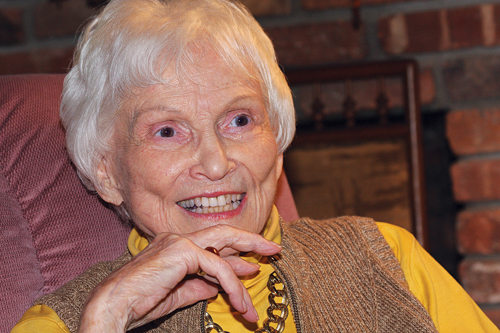
If “The Great Gatsby’s” Daisy Buchanan had a voice that was “full of money,” then Southold actress Peg Murray’s is filled with candor.
The 90-year-old Tony Award-winner was unabashedly honest on a recent afternoon as she recapped her experience at “Raising the Roof,” a star-studded benefit concert celebrating the 50th anniversary of the Broadway premiere of “Fiddler on the Roof.”
The gala was hosted June 9 by the National Yiddish Theatre at Town Hall in Manhattan.
“I helped organize [the event], but I didn’t have much to do professionally,” said Ms. Murray, who played Golde, the quintessential Jewish wife and mother, in the beloved musical from 1969 to 1971.
“They asked me to sing ‘Sunrise, Sunset’ with Chaim Topol [an Israeli actor who played “Tevye” ] and I said, ‘Oh, I’m so sorry, I can’t,’” she said. “Then I had to think about why I couldn’t. And the reason is that I don’t like him.”
She pointed to a pile of papers on a coffee table detailing her extensive body of work in theater and television.
“All those roles I took weren’t by happenstance,” she said. “I’m very picky about what I do. Always have been.”
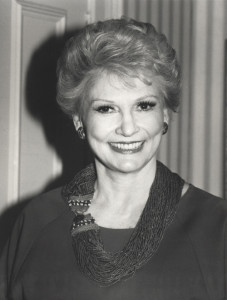
Born in Denver, Colo., in 1924 to parents of Scottish descent, Ms. Murray moved to New York City when she was 5. The Great Depression had just hit and her father, an attorney who had founded a law school in Colorado, went bankrupt.
“He was also a partner at a law firm in New York, thank God,” she said.
Ms. Murray took roles in high school theater productions but “didn’t count them,” she said.
“The difference between amateur theater and professional theater is quite wide,” she explained. “It’s another animal, really.”
When pressed to elaborate, Ms. Murray thought carefully before answering.
“When you’re new, you just want to learn the words and say them,” she said. “But that is so low on the list of a pro, who wants to know who the character is and how you can relate. And then how you can present it. And then how you can present it without looking as though you’re presenting it. It’s not recitation.”
Ms. Murray was on her way to becoming a pro when she graduated from Case Western Reserve University in Cleveland in 1945, and was immediately offered a two-year stint with the Army as a civilian actress entertaining American GIs still in Germany.
“No matter how much you read or you know … when you see it, that’s another thing,” she said of post-World War II Europe. “Germany was rubble. There was no country.”
When she returned to the U.S. in 1947, Ms. Murray and some friends formed a traveling theater group called Touring Players Inc.
“We booked shows ourselves,” she said. “We’d go all the way down to Florida, then Texas and back to New York. It was very successful.”
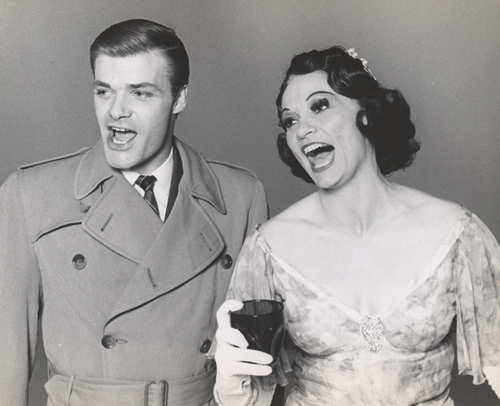
In 1952, LIFE magazine wrote an article about the Touring Players.
“The demand for theater – and for good theater, at that — has showed itself all through the U.S. this season,” the magazine wrote. “It has brought a boom to road shows, has stirred Texas showmen to plan their own local productions of new Broadway hits and has given an obscure but excellent little traveling company, the Touring Players, the best season it has ever had.”
Acting on the road was exciting, fulfilling and sometimes scary, she said. When the troupe began booking gigs at black colleges in the South, they confronted the ugliness of racism firsthand.
In the early 1950s, the Touring Players were performing for a packed audience at Louisiana State College — known at that time as Louisiana State College for Negroes — when Ms. Murray went backstage and heard what she described as a “big bang.”
“I thought, ‘Oh God, a light exploded,’ı” she said. “And my director said, ‘No, Peg, that was a gun.’ There were two or three shots. We were all terribly upset. Later, I talked to the dean of the college and said, ‘Well, did we call the police?’ And he said, ‘Peg, that WAS the police.’
“I nearly died,” she said. “Talk about an education. They were mad that white people were playing for blacks.”
In 1955, Ms. Murray left the acting group in search of more permanent work in New York City. She landed her first major role in the 1956 Broadway production of “The Great Sebastians” starring Alfred Lunt and Lynn Fontaine. She later took roles in “Gypsy” with Ethel Merman, “Anyone Can Whistle” with Angela Lansbury and “Flora the Red Menace” with Liza Minnelli, to name a few.
The theater community rewarded Ms. Murray handsomely in 1967, when she won a “Best Actress” Tony Award for her performance as Fraulein Kost in the original production of “Cabaret.”
She loved winning — “That was self-affirming,” she said — but the attention that came with it was practically unbearable.
“It was one of the worst days of my life,” she said. “The phone never stopped. The door was banging. And the flowers kept coming and coming. All of that, you see, I can do without.”
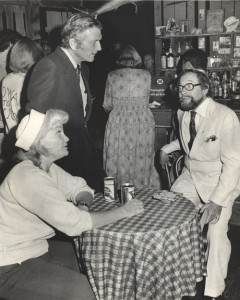
Desiring a slower pace, Ms. Murray moved to her secluded North Fork home around 1970. But she didn’t give up acting: That same year, she replaced Helena Carroll in the role of Leona in Tennessee Williams’ play “Small Craft Warnings.”
The incomparable playwright wrote the following about Ms. Murray in his 1975 memoir: “It will be exciting to see a gifted actress, after such short preparation, take over the demanding role of Leona and to see us all up there giving her our support, covering the almost inevitable ‘fluffs’ as best we can, and loving her as actors must love each other on such critical occasions, if there is love in this world, and I think there is.”
In the 1980s, Ms. Murray joined the cast of “All My Children” and played the role of Olga Swenson for 13 years.
“That was for the money,” she said. “I nearly fainted the first time they gave me a check.”
Between takes, she wrote plays for Northeast Stage in Greenport.
In 1986, Ms. Murray won a role as Ethel Conklin, the lead character in the short-lived NBC sitcom “Me and Mrs. C.”
“I hated every minute of it,” she said.
As much as she still loves the theater, however, Ms. Murray said she has no plans to keep acting.
“It’s not the work — I love to act,” she said. “I find it very easy and they pay me and I’m always surprised. It’s putting on the damn stockings and the high heels and going up and down stairs and greeting people after the show. That I’ve had. I’ve just had it. When you’re in a Broadway show it’s like going to the gym three hours a day.”
That doesn’t mean Ms. Murray has had an easy time adjusting to a life off stage.
“I had a hard time — I still do — with not working,” she said. “I don’t want to, but on the other hand I miss it. Sometimes I don’t know how I did it.”
The attention that comes with winning a Tony Award might have made for “one of the worst days” of her life, but Ms. Murray, who recently attended this year’s show at Radio City Music Hall said she had a wonderful time and enjoyed watching performances by some of today’s best talent.
“The theater is something alive that goes on and on,” she said. “It’s not a piece of celluloid. It’s real people. I thought the whole show illustrated that nicely.”