

Couple sues Greenport church over unholy mess
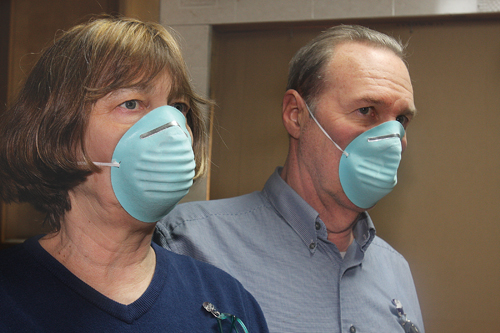
A couple that’s been living in a Greenport church rectory is suing the church for more than $1 million in damages, claiming mold that was allowed to fester in the building for years during their residence there has made them chronically ill.
Thomas Lashinsky and his wife, Laura Wilson, moved into the Holy Trinity Episcopal Church rectory in 2010 and Mr. Lashinsky later began maintaining the parish’s Main Street properties. But things began to go sour last year and in November, they said, the church asked them to vacate the premises. The couple is now claiming church leadership allowed them to live in the rectory amid extensive mold without moving to fully rectify the problem, according to a lawsuit filed in state Supreme Court.
The complaint alleges the situation was created “solely as a result of the negligence of the defendant with no culpable conduct on the part of the plaintiff.”
The church has denied all the allegations in the complaint, according to a response filed by the church’s attorney, James Lynch of Garden City.
“If plaintiffs sustained injuries and damages as alleged in the complaint, said injuries and damages were caused in whole or in part by the plaintiffs’ carelessness, negligence, assumption of risk and or culpable conduct,” the church’s response states.
Mr. Lynch declined to comment on the case.
Meanwhile, church board member Jane Welz has resigned and is assisting Mr. Lashinsky and his wife, who still live in the building. Ms. Welz questions the church’s failure to properly remediate the rectory’s mold problem.
“It breaks my heart,” she said. “I’ll never join another church organization again.”
“All we ever wanted to do was fix up this place,” Ms. Wilson said. “We thought that we could really make it nice. I can’t believe we are in this situation.”
They said that throughout their ordeal — they first noticed mold 10 months after moving in — they had remained hopeful the mold issues would be fixed and life would return to normal. The couple and church leaders only recently reached an agreement that requires the couple vacate the premises by June 30.
Local church leaders and a spokeswoman for The Episcopal Diocese of Long Island declined to comment for this story, but a former part-time priest at the church described Mr. Lashinsky and Ms. Wilson as “squatters.”
“It is a mystery that they want to live there with it being so dangerous, especially when they’ve asked them to leave,” said Father Paul Wancura, who worked part time at Holy Trinity for 10 years before retiring in September. “The church brought them in to help them out. They paid [Mr. Lashinsky] to work for them and he was to give a nominal donation with the rental. If the fellow would just leave with his wife, it would improve his health,” he said.
But the couple says leaving the rectory will be financially difficult. Not only has Mr. Lashinsky’s health deteriorated, they say, but Ms. Wilson has also begun to suffer from blurred vision, memory loss and confusion. He said he is physically unable to work and suffers from dizziness, trouble concentrating and hearing loss. His wife earns money by selling homemade products online.
“We are scared,” he said. “We want to get out of this home so bad right now, but we have no income. We have no money. I don’t know where we are going to wind up living. It might be in our truck.”
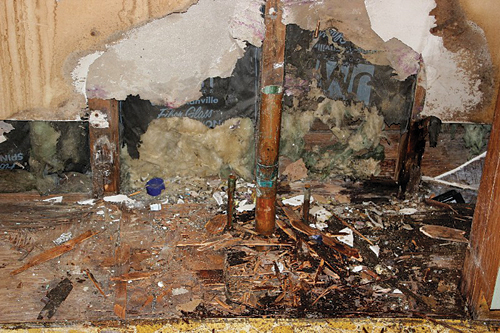
During their time in the rectory, Mr. Lashinsky said, the church had paid in September 2012 to get some of the mold removed. A Suffolk Times reporter visited the rectory on two occasions last month and each time saw mold behind walls that had since been opened during a construction project, as well as in floorboards and in the first-floor ceiling.
As visually unappealing as the mold is, the couple said the smell is sickening.
Mr. Lashinsky says his symptoms have continued to worsen over time and large polyps that obstruct his breathing have now grown in his right nostril. A document he provided to a reporter indicates that a local doctor found “abnormalities” in Mr. Lashinsky’s nose and sinus cavities that “may be or are likely to be in relationship” to his “prior environmental or occupational exposures.”
The report does not directly tie the alleged abnormalities to Mr. Lashinsky’s living in the rectory.
Mr. Lashinsky claims the mold is to blame and that he would need expensive surgery to rid his body of the polyps and fix any other internal damage. The couple said they will be seeking monetary compensation to help cover the cost of surgery and other medical bills as well as money for emotional pain and suffering.
In September 2013, the church hired environmental health and safety consultant Leighton Associates Inc. of Forest Hills to conduct a full survey of the mold in the rectory building. According to the company’s report, provided to a reporter by the couple, three types of mold were discovered, including a “very heavy” presence of black mold in the kitchen sink cabinet, which was deemed “beyond remediation” and which the report recommended be removed completely and disposed of.
“I found quite a bit of mold there,” said company owner Bob Leighton, who performed the inspection. “The airborne mold spores were modestly leveled to highly leveled. Certainly someone shouldn’t live there.”
That was a month after the church was granted a variance by the Greenport Zoning Board of Appeals to convert the rectory into a two-family home.
“They have all kinds of legitimate hardships,” village building inspector Eileen Wingate said in an interview. “They were given a variance to have the two-family house construction started and the mold situation was more intense than they thought, so construction has stopped. I haven’t done an inspection in a while and they have to figure out where they’re going from there. It is an unfortunate thing. It is a beautiful old house, but neglect sets in.”
In its more than 150 years, Holy Trinity has been widely known in the greater community for its good deeds; it has, for example, long served as the headquarters of local Boy Scout Troop 51 and Cub Scout Pack 51.
An assistant scoutmaster said the Scouts have had a very positive experience dealing with the church and its leaders.
“It has been our home for such a long time the troop is really a part of the church,” said Ed Whittle, an assistant scoutmaster. “We never had any issues with the church. Whenever we need to use the church it was just a question of contacting the right people.”